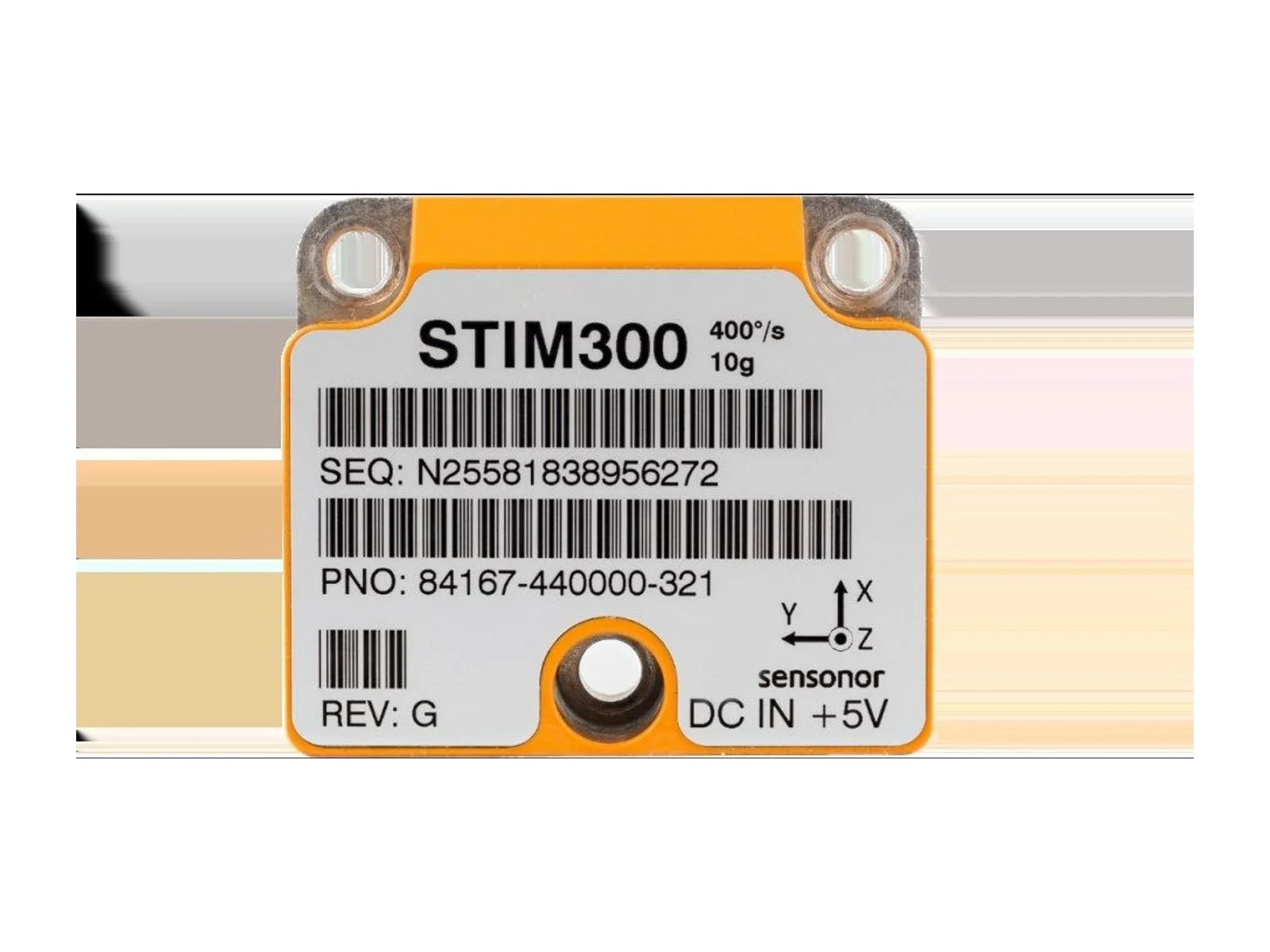
STIM300 is an inertial sensing unit that measures vehicle motion for navigation and control applications. It supplies inertial information to the host system, where attitude or position processing and the aircraft control architecture can use the measurements.
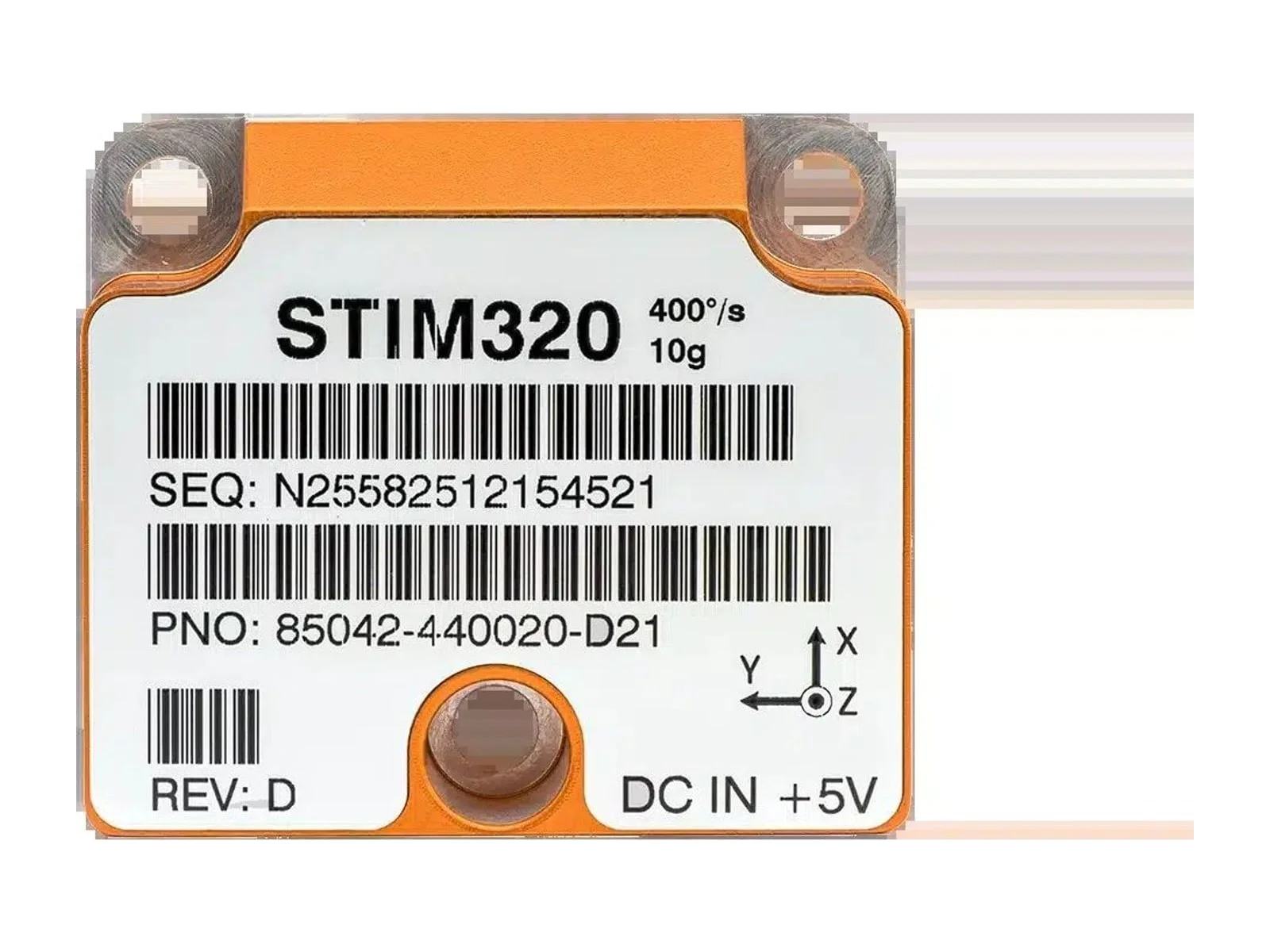
The STIM300 is a tactical grade MEMS inertial measurement unit (IMU) manufactured by Safran Navigation & Timing, with the gyro technology originating from Sensonor. Each unit combines three MEMS gyroscopes, three accelerometers and three inclinometers in one housing and delivers inertial measurements to a host computer. It is a non-GNSS-aided sensor: it reports motion only, and attitude, velocity and position must be computed by the integrator's navigation filter, flight controller or inertial navigation system.
Every axis is calibrated at the factory for bias and sensitivity and compensated for temperature over the full operating range of -40 to 85 °C. The gyros have a bias instability of 0.3 °/h and an angular random walk of 0.15 °/√h, with a resolution of 0.22 °/h and a bias error of 10 °/h rms during temperature gradients of up to 1 °C per minute. Bias instability describes how slowly a free-running heading or attitude estimate drifts, while angular random walk describes the short-term noise that accumulates in the integrated angle. Full-scale angular rate input is ±400 °/s and the output is limited at ±480 °/s.
The accelerometers have a standard input range of ±10 g, with ±5 g, ±30 g and ±80 g listed as optional ranges. Bias instability is 0.04 mg, velocity random walk is 0.07 m/s/√h and resolution is 1.9 µg. The three inclinometers cover ±1.7 g with 0.2 µg resolution and are intended for accurate levelling and alignment at standstill. The mechanical design is insensitive to magnetic fields, tolerates 1,500 g of shock in any direction and is qualified to a high-performance aircraft vibration standard, which is relevant for airframes with rotors, engines or high structural loads.
On the system side the unit weighs 55 g, measures 44.8 x 38.6 x 21.5 mm and runs from a single 5 V supply (4.5 to 5.5 V) drawing 1.5 W typically and 2 W at most. Data leaves the IMU over a digital RS422 serial interface with a transmission bit rate of up to 5.18 Mbit/s, at sample rates up to 2,000 samples per second. Time to valid data after power-up is 0.7 s typically. An external trigger input, a time-of-validity output and an auxiliary input support time alignment with cameras, GNSS receivers and other sensors. Axis misalignment is 1 mrad thanks to electronic axis alignment.
A 32-bit ARM microcontroller makes the device configurable. The user selects the output unit, sample frequency, low-pass filter cut-off, datagram content and RS422 bit rate. Output quantities include angular rate, incremental angle, average angular rate, integrated angle, acceleration, integrated velocity, incremental velocity and average acceleration. The IMU monitors more than 100 internal parameters, among them references, sensor error and overload flags, temperatures, memory and supply voltage, which the host can read for built-in diagnostics. Evaluation tools with USB or PCI connectivity are available.
The maker describes the STIM300 as suitable for stabilization, guidance and navigation in industrial, aerospace and defense markets, with field use in land navigators, missile systems, target acquisition systems, airborne surveillance, directional infrared countermeasures, remote weapon systems, launch vehicles and satellites. For unmanned aircraft and eVTOL integrators it is a candidate for gimbal stabilization, inertial navigation and flight control where a fiber-optic-gyro-class sensor would be too large or costly. The product is ITAR-free.
Specifications
Specifications · STIM300 inertial sensing unit
General
Grade
Aerospace-grade
Market
Dual-use
Platform class
Small UAS (<25 kg), Large UAS (25–150 kg), Heavy UAS (>150 kg), eVTOL, Manned aircraft, Ground
What are the key specifications of the STIM300 IMU?
The STIM300 has three MEMS gyros, three accelerometers and three inclinometers. Gyro bias instability is 0.3 °/h, angular random walk 0.15 °/√h, gyro range ±400 °/s, accelerometer range ±10 g (optional ±5, ±30 or ±80 g), mass 55 g, supply 5 V.
What interface does the STIM300 use and how does it connect to a host?
The STIM300 uses a digital RS422 serial interface at up to 5.18 Mbit/s with sample rates up to 2,000 SPS. It also has an external trigger input, a time-of-validity output and an auxiliary input for synchronization. Evaluation tools offer USB or PCI connectivity.
Does the STIM300 include GNSS or compute a navigation solution?
No. The STIM300 is a non-GPS-aided inertial measurement unit. It outputs calibrated angular rate and acceleration data in selectable formats, and the host system must compute attitude, velocity and position, for example in a navigation filter.
What is the operating temperature and shock rating of the STIM300?
The STIM300 operates from -40 to 85 °C and is factory compensated for temperature over that range. It withstands 1,500 g of mechanical shock in any direction, is insensitive to magnetic fields and is qualified to a high-performance aircraft vibration standard.
What power supply does the STIM300 need?
The STIM300 runs from a single 5 V supply with a range of 4.5 to 5.5 V. Typical power consumption is 1.5 W and the maximum is 2 W. Time to valid data after power-up is 0.7 s typically and 1 s at most.
Reviews & Ratings
–/ 5
No reviews yet. Be the first to rate.
Rate this product
Almost done: send the form below to publish your rating.
Falcon is a reusable supersonic uncrewed aerial target for missile-defense training, and its propulsion is the subject of a partnership between Safran Power Units and UVAD Technologies. Safran supplies two turbojet engines, and flight…
Shield agrees to buy Echodyne, the Kirkland-based radar maker, in a deal valued at $5.3 billion. The purchase brings software-defined MESA radars, used in counter-UAS systems and for UAS detect-and-avoid, into Shield's Mission Systems…
Ouster releases Firmware 3.2 for its lidar sensors, adding on-sensor 3D zone monitoring, optical window blockage detection and time-synchronized IMU data. The update shifts occupancy logic and motion compensation from the host computer to…











 Featured
 Featured
 Featured
 Featured
 FeaturedIMUs
 FeaturedIMUs
 FeaturedIMUs
 FeaturedIMUs