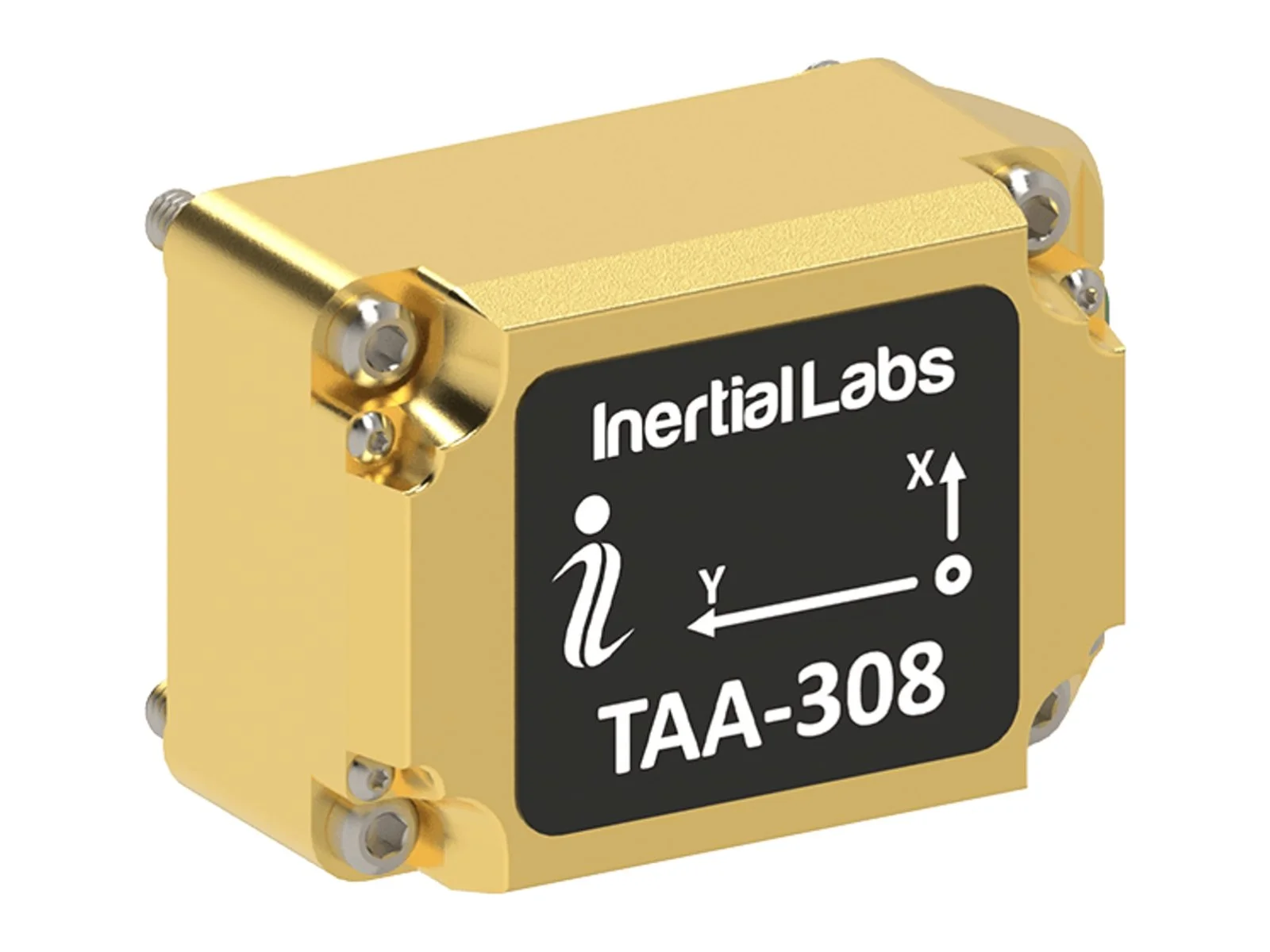
The TAA-308 is a compact three-axis MEMS accelerometer for UAV and AUV/ROV navigation, control and platform stabilization. It measures up to ±8 g, with a velocity random walk of 0.015 m/s/√h and a mass of 13 g.
The Inertial Labs TAA-308 is a navigation-grade, stand-alone three-axis MEMS accelerometer for UAV and AUV/ROV navigation and control. It is a compact, self-contained, strapdown sensor that measures linear acceleration on three axes with low noise and good repeatability, in both motionless and dynamic applications. Inertial Labs builds it on its experience in the calibration of inertial sensors.
In a vehicle, the acceleration data feeds the flight or navigation control system, which follows the vehicle's movement in three-dimensional space and adjusts the propulsion system to keep the platform stable in turbulent conditions and during complex maneuvers. The sensor is fully calibrated, temperature compensated and mathematically aligned to an orthogonal coordinate system. Its outputs are three-axis acceleration, temperature and a synchronization signal.
The measurement range is ±8 g, the largest acceleration reported on each axis. Bias in-run stability is 5 µg, which describes how little the bias drifts during operation and matters most when acceleration is integrated over long periods. Velocity random walk is 0.015 m/s/√h, the noise figure that sets the floor for velocity error in dead-reckoning and navigation filters. Bias residual error, bias one-year repeatability and scale factor accuracy are listed in the datasheet and show how well the calibration holds over temperature and between recalibrations. The output rate is 4000 Hz, so control and navigation loops receive data at a high rate.
The TAA-308 communicates over RS-422 with discrete I/Os, and output data is available in Binary, ASCII and KERNEL formats; communications protocols are configurable. The supply voltage is 4.5–36 V and power consumption is 0.3 W, so it can run from a wide range of vehicle power buses. The mass is 13 g, and the compact aluminum housing is fastened with four captive mounting screws, which suits payload bays, gimbal assemblies and small instrument housings. A continuous built-in test (BIT) monitors the unit. Inertial Labs supplies drivers and tools for ROS, LabVIEW and Waypoint products, and a Software Development Kit is available for custom solutions.
The unit is calibrated over its operational temperature range, and the operating temperature limits are given in the specifications. The sources list no aerospace, military or export-control approvals for this model, so buyers who need a specific certification should confirm it with the manufacturer. Inertial Labs builds the sensor in the USA.
Typical applications are UAV and AUV/ROV navigation and control, platform orientation and stabilization, gimbals, EO/IR systems, antennas and line-of-sight systems. The datasheet also lists autonomous vehicles, motion reference units, motion control sensors, GPS-aided inertial navigation systems, attitude and heading reference systems, guidance and navigation, and passenger train acceleration, deceleration and jerk measurement. Higher-range and tighter-tolerance variants exist in the same product family.
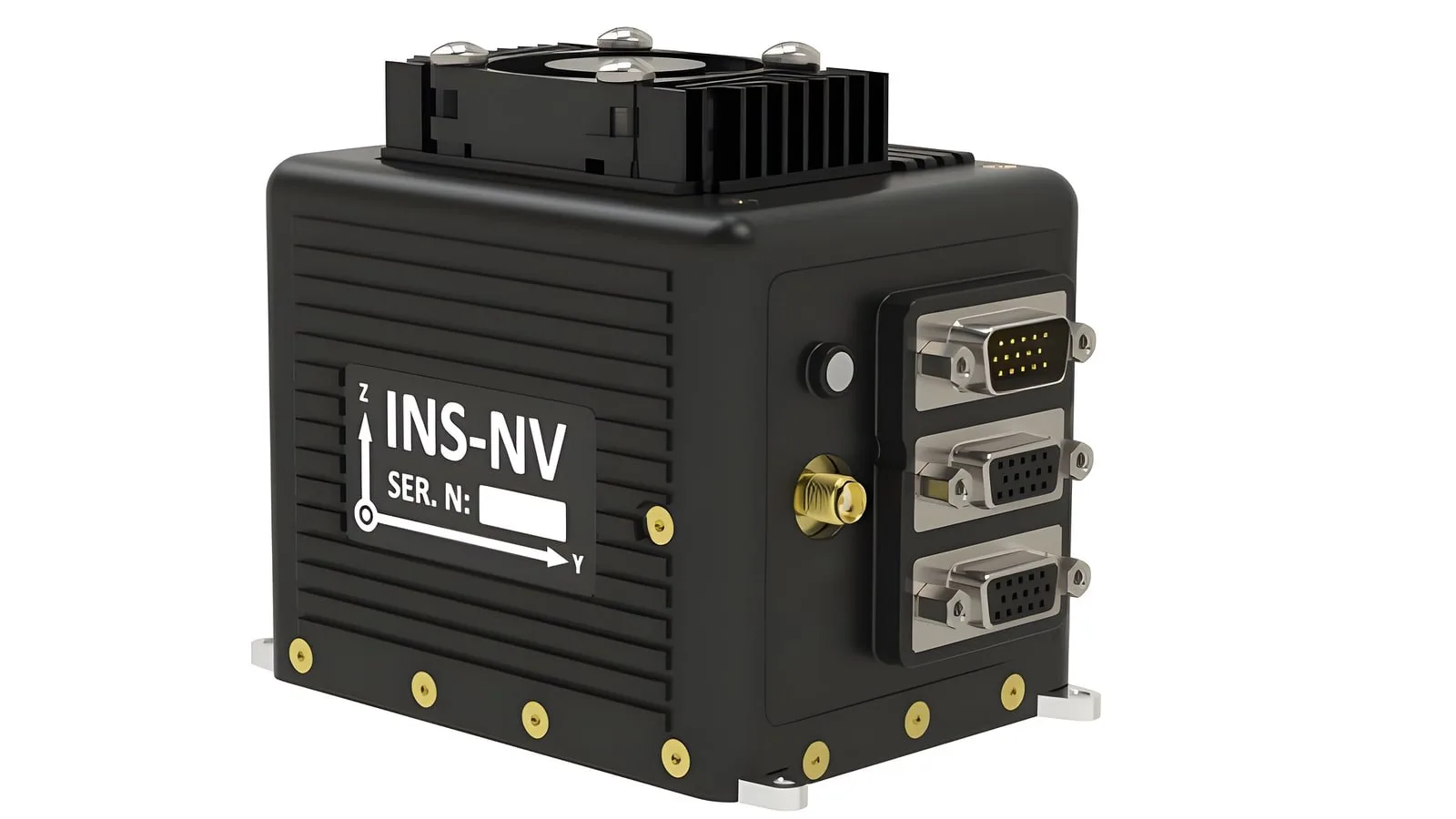
The INS-NV is a new programmable platform from Inertial Labs, which belongs to VIAVI, and it pairs an NVIDIA Jetson Orin NX module with an inertial navigation system and an AHRS. Developers of alternative PNT and visual navigation systems…
Shield agrees to buy Echodyne, the Kirkland-based radar maker, in a deal valued at $5.3 billion. The purchase brings software-defined MESA radars, used in counter-UAS systems and for UAS detect-and-avoid, into Shield's Mission Systems…
Ouster releases Firmware 3.2 for its lidar sensors, adding on-sensor 3D zone monitoring, optical window blockage detection and time-synchronized IMU data. The update shifts occupancy logic and motion compensation from the host computer to…











 FeaturedIMUs
 FeaturedIMUs
 FeaturedIMUs
 Featured
 FeaturedIMUs
 FeaturedIMUs
 FeaturedIMUs
 FeaturedIMUs