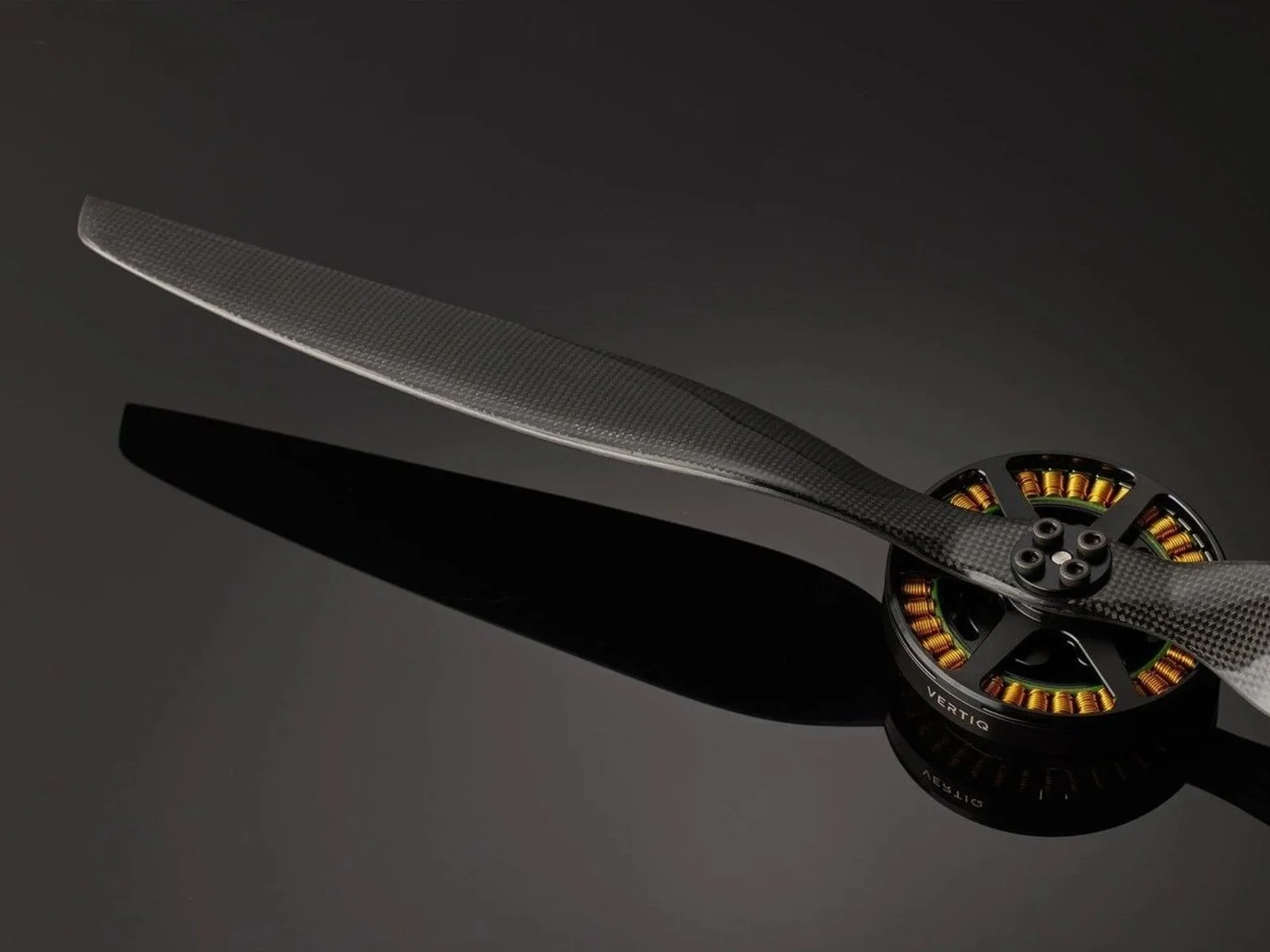
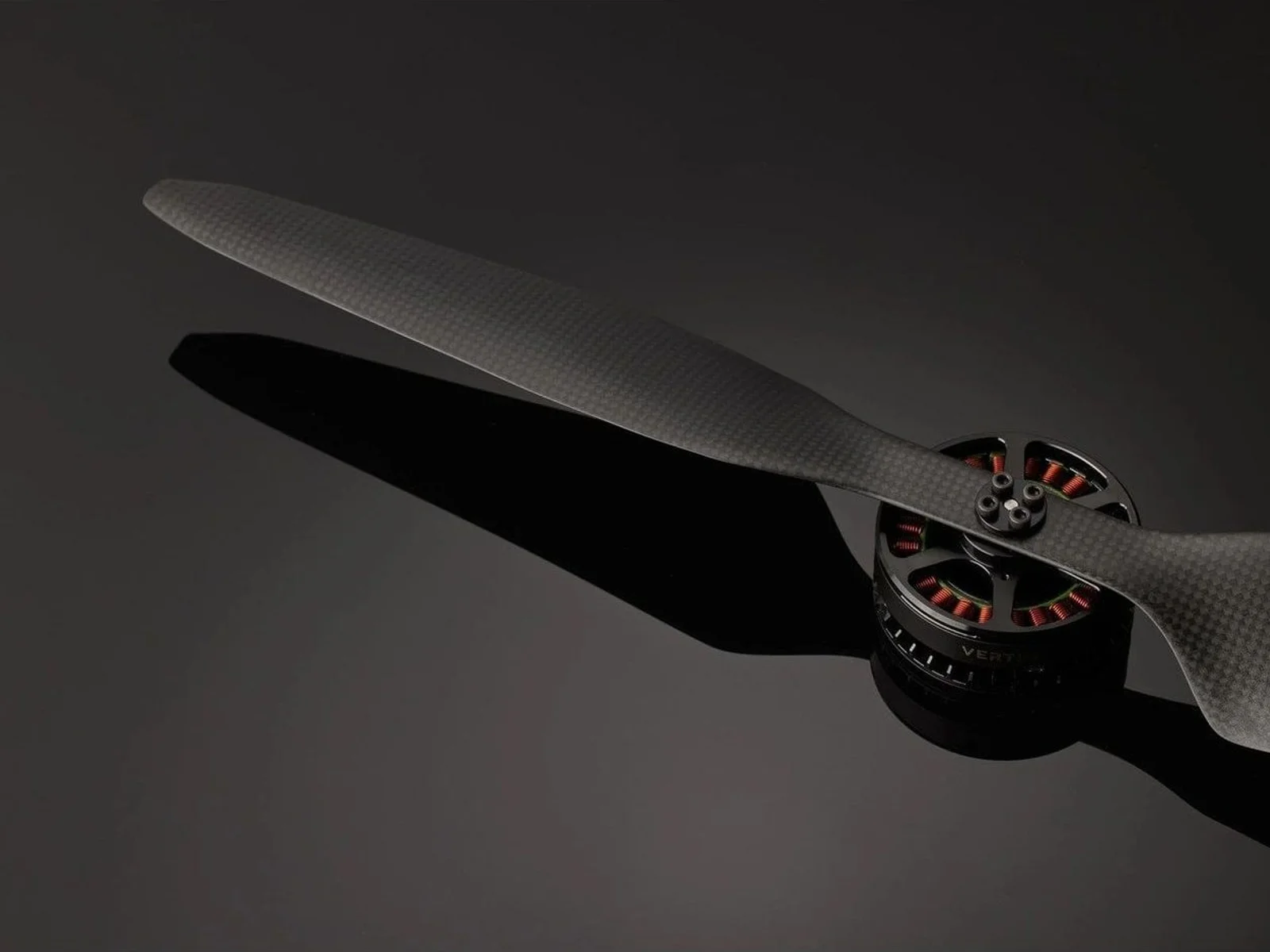
The 81-08 G2 module combines a propulsion motor, position sensing and an electronic speed controller. Its sensored control supports reversible operation and braking, with motor winding and module configuration selected for the aircraft installation.
The 81-08 Module is an integrated motor and ESC propulsion module from Vertiq with an integrated controller. The 81-08 G2 module, part number VERT-M28.1-E16.1, is an integrated motor and ESC propulsion module from Vertiq. It is a brushless electric motor of the 81-08 size with a speed constant of 85 Kv, combined with a 14S, 60 A continuous electronic speed controller and a position sensor in one unit, designed for drone propulsion and robotics.
The module is intended to drive propeller loads on multirotors and other electric aircraft. Because the position is sensed, the controller works without desync, supports 3D reversible operation without delay at zero crossing and can run at any speed from -4900 RPM to 4900 RPM. Regenerative and active braking, active freewheeling and coast modes are available, and the motor is backdrivable. An optional multi-turn angle firmware adds a position controller with a minimum-jerk trajectory generator, and anticogging is available on request.
Three nested controllers can be selected: an integrated PID velocity controller with a second order polynomial feed forward, which suits propellers, a voltage controller that compensates for varying battery voltage and a raw PWM controller. For the integrator, the voltage controller keeps thrust consistent as the battery discharges, and the velocity controller gives a stable response without a separate flight-controller loop.
The main figures are a torque constant of 0.112 N m/A, a motor resistance of 0.202 ohm (0.219 ohm including the controller) at 25 °C, a pulsed current of 50 A for 100 ms, a no-load speed of 139.4 rad/s and a no-load current of 0.4 A at 15 V. The mass is 292 g in the base configuration and 313 g in the default configuration, both without wires. The recommended supply is 12 V to 60 V, corresponding to 4S to 14S batteries, with caution above 12S, and regenerated energy must not exceed the voltage limit, so the built-in regeneration limiter or an external load is needed. The recommended ambient temperature is -20 °C to 50 °C, and the controller reduces performance as it approaches its limits.
For integration, the communication protocols are DroneCAN, DShot (150 to 1200), 1-2 ms PWM, serial UART with access to control parameters, Oneshot and Multishot. The connector board carries up to two CAN connections wired to the same bus, power pads, RX/TX pads and three GPIOs. The mounting uses M4 and M3 threaded holes. The module can be shipped without the stator cover and connector board, so wire exits and IP ratings up to IP56 can be defined by the customer.
Protection functions include over-current, over-voltage, over-speed and over-temperature protection, motor health monitoring, standard and custom telemetry, and a safe arming procedure.
Specifications
Specifications · 81-08 G2 integrated motor and ESC propulsion module
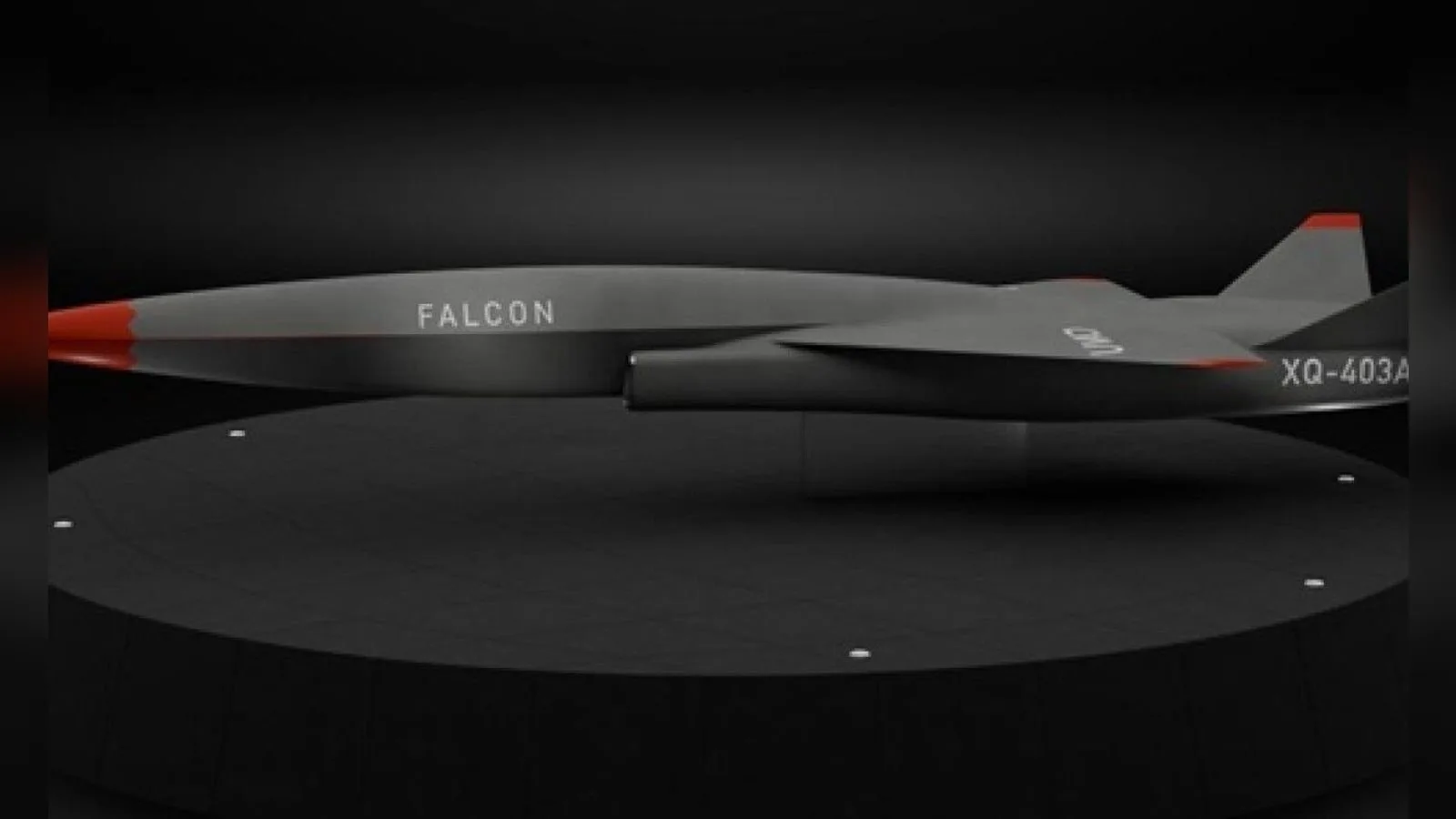
Falcon is a reusable supersonic uncrewed aerial target for missile-defense training, and its propulsion is the subject of a partnership between Safran Power Units and UVAD Technologies. Safran supplies two turbojet engines, and flight…
Honeywell Aerospace tests a 1 MW generator in a Mexicali test cell, and Flying Whales will integrate it into the hybrid-electric powertrain of its LCA60T airship. The unit reaches 1 MW steady state at 97% efficiency, giving…
Honeywell Aerospace presents the HON1600, a small turbine engine it positions for the US Air Force's Collaborative Combat Aircraft (CCA) program, after a core engine run in September 2025. The Air Force has issued a request for proposals…











 FeaturedElectric motors
 FeaturedElectric motors
 FeaturedElectric motors
 FeaturedElectric motors
 FeaturedElectric motors
 Featured
 FeaturedElectric motors
 FeaturedElectric motors